Thursday, June 29, 2006

Are Your Walls Fortified?


In ancient times it was customary to build walls around a city to protect it's inhabitants from marauding bands and enemies. The farmers and shepherds knew that they could enter the gates of the city for protection should attacks come.

Proverbs 25:28 says: "Whoever has no rule over his own spirit is like a city broken down, without walls.

Or, in other words: A person who lacks self control is defenseless and opens the door to things that can tear them down.

Where are your walls being torn down? And how can we keep our defenses built up?

Proverbs 30:5 tells us that Every word of God is pure; He is a shield to those who put their trust in Him. And;
2 Timothy 3:16-17 teaches us All Scripture is given by inspiration of God, and is profitable for doctrine, for reproof, for correction, for instruction in righteousness, that the man of God may be complete, thoroughly equipped for every good work.

A recent survey was conducted concerning pastors who had fallen away for one reason or another. The most common cause that was given was that they had become too busy and had let their time reading God's Word lapse.

Daily study and meditation of God's word, along with other ways of "Putting on the Armor" will keep our walls standing strong.

Friday, June 23, 2006

Do You Want To Know A Secret?

We like secrets, especially when we stand to benefit from knowing a certain secret. Secrets are alluring and to possess a secret can make us feel powerful and in control. On most covers of any magazine you will discover that you too can possess the secret to happiness; tight rock-hard abs and buns of steel; how to retire by age 50; becoming a fabulous cook, losing 10 pounds is seven days, and many other secrets that will make us healthy, wealthy and wise.

Then there are those secrets that we carry within us that we never want to reveal. Perhaps the fear of guilt and shame and the risk of being rejected run too deep for many of us. So we hold on to our secrets for the perceived power we feel by maintaining control.


We all have secrets; everyone of us. We don't have to be ashamed of our secrets before God.

This morning I meditated on Matthew 6:1-6, 16-18. This is the lesson about charitable deeds where Jesus instructs his hearers not to be concerned about outward appearances and being seen by others but to enter the secret places of our hearts where God sees in secret. Jesus said that God is in the secret place.

We don’t have to hide in secret from God.

All too often, it is much easier for me to focus on my outward appearance and actions than it is to enter my room and reveal to God the hidden and set apart places within. I can get caught-up with “performing” the ritual and never be inwardly transformed in the secret places in my soul. Cistercian monk Michael Casey says, “Outward observance, however holy, cannot take place of the personal encounter with the Living God.”

For Jesus, this personal encounter with the living God often takes place with in the hidden parts of me. Within my soul live my hopes, lust, dreams, guilt, shame, greed, joy, fear, and every other thing I can imagine. And according to Jesus, God is in our secret places. There is safety with God in those inner places where we often feel vulnerable and unsafe.

God doesn’t live outside the context of my secrets. “Can anyone hide in secret places so that I cannot see him?" There’s me, my secret, and God. I am not alone with my secret, God is there. “God knows the secrets of the heart.” Psalm 44

God loves us and has not abandoned us to be left alone with our secrets. God is there. God is Love. Love is there in the hidden places that we often feel so unlovable.

So this morning as I prayed and meditated I let God in on the secrets of my heart for there is freedom to acknowledge what God already knows; there is freedom in knowing that God hasn’t rejected, denied or despised me as a result of my secrets. God doesn’t reject me or run away from me because my secrets but begins the inward transformation as I share my secrets; as I reveal who I am. God’s grace abounds in my secret place; God begins to free me to live with authenticity. It seems that my secrets have the ability to keep me locked-up or the ability to set me free, it all depends on what I do with my secrets. There’s the old saying in AA, “We’re only sick as our secrets.” I don’t have to pretend or act righteously in the eyes of people to be accepted or approved while harboring secrets in my soul.

Instead I go to my room and open the door of my heart and share my secrets with the God. I find comfort that God is there.

Wednesday, June 21, 2006

The Life We Live


Chaim Potok, author of The Chosen, captures what it means to live well: “Human beings do not live forever. . . . We live less than the time that it takes to blink an eye, if we measure our lives against eternity. . . . A blink of an eye in itself is nothing. But the eye that blinks, that is something. A span of life is nothing. But the man who lives that span, he is something.”

Second Timothy paints an incredible picture of the confidence we can have on the eve of our death when we have lived well. Paul had that kind of confidence. At the time that 2 Timothy was written, Paul was imprisoned for a second time in Rome (1:8) and was awaiting execution (4:6). Many of his closest friends and ministry partners had deserted him. His prison chamber was cold and dismal (4:13). Despite his bleak circumstances, Paul’s joy and hope in Christ were not dimmed as he considered the “promise of life that is in Christ Jesus” (v. 1). Death awaited him, but it was not the end. Life in Christ is a promise for eternity.

So with this joy for the future, Paul began his letter with expressions of thanks, specifically thanking God for Timothy. Paul was obviously comforted by the friendship that he enjoyed with Timothy. He was thankful to know that while others had deserted him, Timothy remained faithful both to Paul and to the ministry. The tears Timothy had shed at their last parting assured Paul of the warmth and loyalty he felt for the apostle.

Yet Paul was not only comforted by Timothy’s loyalty but also by his sincere faith (v. 5). When so many around him had shipwrecked their faith, Paul might easily have begun questioning his efforts as an apostle. But Timothy was a “success story,” a reminder that sincere faith could indeed survive, and that Paul’s ministry efforts had taken root, been blessed by God, and had in fact borne fruit.

Friday, June 09, 2006

God's Unconditional Love


New believers may find it difficult to accept the fact that God loves us just as we are. Much of the world operates by conditional love, which offers approval and acceptance on the basis of performance. So when we first come to Christ, there is often a natural tendency to assume we must strive to "deserve" our blessings, such as wealth, happy families, or good careers.

Divine love, however, can never be earned by human effort. There is absolutely nothing we can do to make God love us more or to influence Him to stop loving us. (Romans 5:8; 1John 4:8) Many believers understand this intellectually but have trouble believing it deep down in their hearts.

No matter what has occurred in your past or what you feel right now, the Father's love has always been freely given to you.

God pours His love upon us without exception- no ifs, ands, or buts.

He did'nt begin to love you the moment you asked Him into your life. Nor did He begin loving you because you went to church or rose out of the baptismal waters.

In truth, God never "began" to love you at all; He simply always has. From the creation of the world, God knew you and loved you. (1John 4:19, Psalm 139:13)

Are you rejoicing in the Father's love, or are you withdrawn and depressed? Do you exude peace, or do you always seem anxious? Is your life characterized by power and purpose or by fear? Recognizing the amazing truth of God's unconditional love is life changing. Prayerfully open your arms to His love today!

Tuesday, June 06, 2006

Broken Windows


When Rudy Giuliani was Mayor of NYC he requested that when a building was discovered to have a broken window that the broken window be replaced immediately because if it wasn’t, within a couple of months most of the other windows in the building would be busted-out as well, leaving the building looking abandoned.

Apparently folks are more apt to destroy what appears to be already on a path of being uncared for and valueless.

People are a lot like buildings.

It seems that many people who have had a window or two broken out of their lives are often the ones who are pelted with stones leaving the remainder of their windows to be shattered. I guess in ways all of us have a cracked window or two.

Think of the people you know with shattered windows. I am reminded of a boy in my elementary who was picked-on by another kid. For whatever reason he hated this boy and everyone knew it. He demonized him and publicly shattered a window in his life. It wasn’t long afterwards that other students began to throw stones at his windows. Throughout our elementary years this particular boy, for no reason other than having a window cracked through the senseless and unkind words and actions of another person, was pelted with stones on a daily basis. If the eyes are truly the window of the soul, it was easy to look in his eyes and see the brokenness.

It only takes one person to start the cycle of destruction, and before long the entire building is in shambles. We take something beautiful and in our inner-ugliness attempt to break it so that it will also be ugly, just like we feel. And once we perceive it to be ugly we justify destroying it. Some feel justified throwing rocks at whatever they find valueless and ugly.

God doesn’t throw rocks.

Jesus knew what the damage of one stone could do to a person. Before long the entire crowd joins in. There’s the old saying, “Hurt people, hurt people.” Perhaps you could say, “Broken people break people.”

Adults are equally as guilty of breaking windows in the lives of others—especially those who already have a window or two busted-out. We don’t like ugly, dilapidated-looking “buildings” so we avoid those with broken windows like we do the run-down parts of town or we help break-out the remaining windows.

Jesus asks us to follow him to the discarded, forgotten, neglected and forsaken parts of town where the "buildings’" windows are broken; the "buildings" are abandoned and left to rot by society. When we dare to look into the windows of another’s soul-- we’ll find God waiting for us to bring about restoration and renewal.

Wednesday, May 24, 2006

Trials


Let's see if you are like I am. Most of the time I would say that I face trials and tests with a steadfast faith; an acceptance that this is His will and how can I learn from it. BUT, there are those other times when I wonder,(and wander), if there will ever be an extended period of time when I will have complete serenity. (I'm now picturing a Tibetan monk in a garden with water gently rippling down a stream, as a butterfly alights on my knee).

But seriously. Troubles are an unwelcome fact of life, but they can have value. Often what we wanted to avoid turns out to be the very thing we needed. God asks that we have a tender heart, a teachable spirit, and a yielded will.

Does that describe you?

I would say that I have some problems in all three areas.

Do we have a longing to always follow God's ways? Read Psalm 42:1

Are we willing to be taught by the "classroom" of His choice? Read 1Sam. 1:1-2:10; and John 11:17-27

Are we committed to His will? Read 2 Cor. 5:7; and John 15:5

Friday, May 12, 2006

Without Love

The next time you are sitting out on your porch in the beautiful spring evening or wake up to the welcoming sunrise and smell the crisp morning air on your way out to work, consider the seemingly endless hatred that occurs in other parts of the world. I was struck with the contrasts between that and what I experience in my surroundings.

The violence on the South Korean border; the continued atrocity in Darfur; the Taliban spewing hatred in the court room; the tendency to bash our country’s leaders instead of praying for God to give them wisdom; and the list goes on. Here I am in my peaceful surroundings while being bombarded with stories of violence, rage, and hate. I was thinking to myself how sad it is that humans continue to devastate one another. Where does this dark, evil hatred and violence from?

The God who created the birds that fill the morning air with voices of tranquility and peace created people who fill the world with destruction and chaos. How can this be?

In my morning devotion I focused on the Corinthians 13 and it became clear that I often feel the same rage and anger toward those folks who I view as a threat to my sense of security and well-being.

Like the guy in the SUV, who while talking on his cell phone and exceeding the speed limit by 20 MPH nearly hit me as I started to pull out in front of him. He laid on his horn for several seconds, looked at me with disgust and shook his head. I really wanted to mouth two words to him so that he would know exactly what I thought of him. I could have also included some sign language just to be certain he understood how I felt.

To be embarrassing and shamefully honest there was a split second that I thought to myself, “I dare you to get out of your car. I will make you eat that cell phone.”

Out of the same heart that tells my wife she is beautiful; out of the same heart that says, “I love you Jesus”, out of the same heart--
speaks wicked rage. This should not be.

This morning it hit me, in many ways my heart is no different at times than those barbarians I read about in the newspaper. I am capable of some extreme feelings and potential acts of hostility despite my claims of spirituality and being a follower of Jesus.

I may not act on my impulses but it seems to be only by the grace of God that I don’t.

My heart needs help.

When I respond to another’s actions that threaten my sense of well-being and security with hatred or rage I am no different than those I accuse. Jesus said that it’s what comes out of a person that corrupts the person. What comes out of me is apparently what was in my heart—evil. I could have rationalized and justified a stupid, ego-driven, fear-based sense of rage. In the dark corners of my closet I am no different than many of those thugs I hear about on the news. I found this to be shocking—and very humbling.

At times I am nothing more than a loud gong and a clanging cymbal; the noises that drown out the beauty of the birds who fill the earth with God’s beauty and serenity.

I may have the faith to move mountains but not the faith to allow God to remove the mountain of self-righteousness inside of me that prevents me from being love.

I may cherish the hope for more peace in the boundaries of humanity but I don’t possess the love within the boundaries of my own heart to help create the peace that I hope for the world.
I can possess much hope and faith to see change in the world but without love on my part, its all for nothing.

Wednesday, May 10, 2006

Faith in The Storms


It's easy to have faith that God is going to do something in the distant future. For example, if you walked into church and asked the congregation,"Who believes that Jesus Christ is returning?" nearly every hand would go up. But if you ask a guy who is drowning in debt if he thinks God can eliminate his debts in three months, he's likely to express doubts. And yet our day-to-day life is where we must practice unswerving faith if we hope to be effective for the Lord.

James (chap.1) tells us that our faith can't be like the waves of the sea that rush first in one direction and then seem to double back on themselves and race the opposite way. In the Christian life, we rush forward to do the Lord's will until He makes a difficult request or allows a painful experience to come into our lives. Suddenly we are driven in the other direction by our doubts.

The reason we hesitate to trust God fully is that we judge our circumstances by what we see. Sight is the enemy of faith because our eyes and brains can't envision a way for God to do what He promises. Our knowledge of scripture tells us that our faithful God can do anything, yet we forget and doubt.

Faith can overcome doubt only through action. We must turn a blind eye to circumstances and make the first step toward doing God's work. If we exercise our faith every day, those seas won't be so rough.

Monday, May 01, 2006

Practicing Discernment


Spiritual discernment develops slowly. The Lord doesn’t simply pour knowledge into our heads; we must seek His will daily and study to understand Him better. To do so, we need to regularly spend time in the Word and place ourselves under the Holy Spirit’s teaching.

I know, I know… easier said than done… right?

Church is where we receive instruction. If a poll were taken as people left weekly services, they would give many different reasons for attending: worshipping, fellowshipping, encouraging one another, and inviting others to receive Jesus Christ. How many would say they come to learn righteousness? Yet, teaching about holiness is a primary calling of the pastor. (Ez. 44:23)

A minister’s goal should be to teach in such a way that parishioners hear a godly principle and learn to apply it. In this way, believers grow in spiritual discernment.

Instruction doesn’t do any good unless we practice what we learn. David exercised spiritual discernment throughout his life. He went against conventional military wisdom, facing Goliath armorless and with a few stones. (1 Sam 17:37-39) Later, he repeatedly avoided claiming the throne until God’s plan was fully revealed. But David made mistakes as well, such as his indiscretions with the married Bathsheba. We, too, can ignore the Spirit’s promptings and instead appease our own desires.

Recognizing principles is not enough; we must live out what we learn. It’s wise to observe the consequences of obedience and disobedience so that we, like David, can grow in our spiritual discernment.

Friday, April 28, 2006

He Works All Things!


Romans 8:18-30
James Lindsey Smith’s ordeal was “a thrilling narrative of escape.” Under cover of darkness, he and two other men sailed a small boat from Virginia to Maryland. There the men were separated, and Smith managed to avoid detection as he walked alone through Delaware to Pennsylvania. Along the way a woman fed him. In Philadelphia, a man secretly sheltered him and arranged to get him to New York. There he met others who helped him travel to Norwich, Connecticut, where he settled, married, and became a preacher.
The year was 1838 and Smith was a black slave. Like thousands of others, his journey on the “Underground Railroad” was conducted by nameless individuals who assisted and protected him. With their help, Smith eventually made it to freedom. In a similar way, believers are on a journey from bondage to glorious freedom (v. 21). Along the way, we’re helped in our weakness by the Spirit, who intercedes for us and leads us according to God’s will.
But before glory, there’s much suffering. On the one hand, our present suffering doesn’t compare to this future glory (v. 18). In fact, this glory will be so great that the entire creation groans eagerly for it! Because we have the Spirit, we too groan, because deep down we know that this present life isn’t all there is. We long for our resurrection bodies, which will be free from corruption and decay.
On the other hand, however, God knows that our present suffering could overwhelm us, so He assures us of two things. First, we’re not alone. The Spirit helps us in our weakness and translates our groaning into inexpressible words before the Father. Second, God assures us that He’s working redemptively in every circumstance we encounter (v. 28). This doesn’t mean that things will turn out how we expect, or that we’ll have comfort and ease. Rather, it means that God uses every situation to make us more like Jesus Christ. What an amazing assurance, even in our darkest trials!

Thursday, April 27, 2006

Moving Mountains


We Christians have the capacity to believe God for far more than we are willing to ask Him to do. Instead of demonstrating a solid conviction of His faithfulness, we often act out of weak, halfhearted belief.

The Lord is waiting for us to come to Him in complete trust.

The people who are living the richest spiritual lives are those who expect the Lord to do great things- they exercise the gift of faith.

Exercising faith can't be passive. Notice how action words follow every mention of faith in Hebrews 11 (prepared, obeyed, and lived). Instead of folding our hands and waiting for God to do something, we need to get busy. Our first reponibility is to go before the Lord with our petition, often more than once. Then, we must consciously decide to trust Him for an answer and wait with the assurance that He will always follow through with His promises.

We have the potential for Him to work powerfully in and through us. Of course, He doesn't ask us to tackle more than we can handle.

Start today by giving Him the small anxieties that plague you. Or ask God for one change you want Him to make in your life.

Monday, April 17, 2006

Praying Specifically


Look around any day, and you'll see people who need to make changes in their lives. Maybe you have a brother who doesn't know Christ or a believing friend who struggles with lust or can't keep from gossiping. The most powerful way to effect change in another person's life- or our own- is by praying. God, through the apostle Paul, has given us a prayer pattern that is Christ-centered and specific.

Too often, we are lazy in prayer. We say, "Lord bless so-and-so" without giving a single thought to what form the blessing should take. God does not work in generalities; He makes deliberste movements in every person's life. And He is pleased when we use His Word when talking with Him. Paul's prayer from Colossians 1 includes God's greatest desires for His children. He delights in responding to requests that someone be filled with the knowledge of His will and a desire to please Him!

Results may not be instantaneous. We could wait months or years before we see a loved one turn to Christ or witness a beleiver bearing fruit. But remember that The Lord is working all things, even if we don't see it. Our responsibility is to keep praying in a Christ-centered and specific manner.

Wednesday, April 12, 2006

Get Out Of The Way


Have you ever noticed how we spend so much time trying to "get" what God wants us to receive?

We always want our miracle, but we don't get out of the way.

I recently read in 1 Samuel 13 where the prophet Samuel told King Saul to wait for him to return to offer a burnt offering to the Lord before going into battle against the Philistines. Saul waited the alloted 7 days, and when Samuel didn't show on schedule, Saul got nervous and took it upon himself to make supplication to the Lord himself. Because of his lack of faith, God's blessing was taken from him.
In another case, Abraham and Sarah were promised a child in their old age. They waited and waited, and finally, Sarah decided that she had the solution. Abraham should lay with her maidservant. As we all know, that was not God's plan.

At least in my life, I have found that every time I try to take care of it for Him, it only breeds frustration. It's only when I say, "That's it, I'm finished. I can't do it anymore", that He can do His best work in my life.

That's a key word there. BEST.

Saul still defeated the Philistines that day
Sarah ended up having the promised child, but there was and is a rift to this day between the descendants of Isaac and Ishmael.

God will still work through us, around us, and in spite of us, but to receive His best, we need to get out of the way.

Wednesday, April 05, 2006

Ever Feel Resentment?


Resentment is like taking poison and hoping the other person will get sick.

Resentment is an unmet expectation.
Resentment: Indignation or ill will felt as a result of a real or imagined grievance.

Do you have any resentment?

Think about the people you resent. You know them when you see them. What do you do? Increasing irritability and difficulty letting go of resentment can be signs of depression.

I am in a decent place right now, but it doesn’t take long to begin to feel resentful toward a person, especially if I don’t deal with my sense of frustration or hurt immediately.

I don’t like resentment because I am the one who gets sick—not the person I am resenting.

I’d like to say that I attempt to address my issues with another person upfront and as soon as possible- but I don’t. I’d feel so much better. Sometimes it is only after the fact and I notice my feelings. Right then, I should make myself go to the person and let them know what I'm feeling. My wife is really good at that (one of the many reasons I love her). You'd think that it should be easier with family members or close friends, but, at least for me, it isn't. I think I'm afraid of hurting a relationship, where in reality, I'm probably not giving the other person enough credit to accept my perceptions maturely. I need to dwell on that a bit. Anyway, I’m sure I would find that I am much less sarcastic. I need to remember that I’m doing it for myself. I’d probably sleep better as a result. And I bet I’d find I spend considerably less time working through forgiveness or attempting to forget.

Even with the simple things.

Poison is substance that causes injury, illness, or death. Resentment poisons me.

Wednesday, March 29, 2006

Sell Your Soul For A Quick Buck


Here we go again.

There is yet another book coming out disputing the divinity of Jesus our Christ.
I saw an interview with the author of "The Jesus Letters" the other day on a national news program. These letters supposedly support the claim that Jesus not only conspired with Pontius Pilate to fake His death, but He continued to live another 45 years and wrote letters claiming that He was not the virgin born Son of the Living God.

An interesting point: The interviewer quoted the author, saying, "There is incontravertable evidence in these letters." The interviewer commented that that was a very strong statement and asked if the author had ever seen these letters. To which the author replied, "I have never seen them, but was told about them by a reputable Theologian."

1 Timothy 4: 1-2
The Great Apostasy


1 Now the Spirit expressly says that in latter times some will depart from the faith, giving heed to deceiving spirits and doctrines of demons, 2 speaking lies in hypocrisy, having their own conscience seared with a hot iron

Wednesday, March 15, 2006

Clear the Temple!


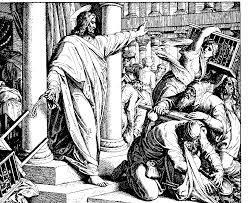
“In the temple he found people selling cattle, sheep, and doves, and the money changers seated at their tables. Making a whip of cords, he drove all of them out of the temple, both the sheep and the cattle. He also poured out the coins of the money changers and overturned their tables.” John 2:14-15

What are the tables that need to be kicked over in your life? Who are the money changers that crowd the temple of your soul that need to be driven out of your life so that you can make space for God?

I think it is all too easy to immediately go to those negative areas of our “character defects” and think that we must cleanse ourselves of all our impurities.

Perhaps what needs to be driven out of our lives is fear, perfectionism, and worry etc. and from the religious laws and rituals that we attempt to abide by in order to make ourselves acceptable and pleasing to God. Perhaps what needs to be slaughtered and given up to God is our idea that we are unlovable and undeserving of our Creator’s love based on our merits, instead of God’s grace. Isn’t this one of the main messages of Jesus? He begins to break laws and codes that have robbed people of their humanity and dignity and he claims God’s love for all people, especially those kicked to the roadside by religion.

When we cleanse the temple it makes those who want to control God uncomfortable and paranoid but frees us to encounter God in our soul and to loosen our grip and enjoy the ride. Then we can say , "Look God, no hands!"

Monday, March 13, 2006

The Journey


"It seems that Christians have been worshipping Jesus' journey instead of doing his journey. The first seems religious, the second seems human." Richard Rohr

What makes one a Christian?

Depending on who you ask, you'll get various answers. Some would say Baptism as a sacrament makes one a Christian; it is a work of God's grace.

Some would say belief and then have a set of doctrines to follow.

Over the past several years I have been asking myself how Jesus would answer that question. I'm beginning to believe that doing his journey is what he desires.

It seems that doing his journey is being committed to a person-- Jesus. The other seems to be more about religious belief and doctrine. How does our faith impact, not our individual lives, but also the lives of those around us? His message was much, much more broad than an individual, personal salvation.

Many spend a great deal of time talking about why Jesus died but perhaps another relevant question is, why did Jesus live? What did Jesus live for? It seems to me the very thing that he lived for was the reason that some tried to kill him.

At some point we are to walk in his shoes or at least in his footprints.

What do you think?

Tuesday, March 07, 2006

Giving it over

Luke 18:22 "You still lack one thing. Sell all that you have and distribute to the poor, and you will have treasure in Heaven; and come, follow me."

Jesus Christ says a great deal that we listen to, but don't necessarily hear. When we do hear, His words are amazingly hard to take.

Jesus made no attempt to keep the guy with Him. He simply said-Sell all you have, and come, follow Me. Our Lord never pleaded, He never cajoled; He simply spoke the sternest words mortal ears ever listened to, and then left it alone.

Have I ever heard Jesus say a hard word? Has He said something personally to me that I deliberately listened to? Not something that I could expound on or negotiate around, but something un-compromising.

This man did understand what Jesus said, he heard it and he sized up what it meant, and it broke his heart. He didn't go away defiant; he went away sorrowful, thoroughly discouraged. He came to Jesus full of the fire of earnest desire, and the word of Jesus froze him; instead of producing an enthusiastic devotion, it produced a heartbreaking discouragement.

Our Lord knows perfectly that when we have heard His word, sooner or later, it will bear fruit.
We will stay at that point until we give it, release it, reject it, etc. I wonder what we will say when we do make up our minds to be devoted to Him on that particular point?

One thing is certain, He will never cast us away.

Friday, March 03, 2006

Holy Spirit Study 2

It is important that the Old and New Testaments are in synch with respect to the Holy Spirit's deity. In Exodus 31:3, the word Elohim is used for the Spirit of God, while in Isaiah 11:2, the word Yahweh is used for the Spirit of the Lord. In Romans 8:9, Paul makes it clear that the OT refers to the deity of the Holy Spirit.

Numerous Bible texts show that the Holy Spirit is God, since He is ascribed the same qualities as God the Father. He is eternal (Heb.9:14); He is all knowing (1Cor.2:10-11); He is all powerful (Rom.15:18-19); and He is everywhere present (Ps.139:7). The names of the persons of the Trinity are also joined in a way that implies full and complete equality of Being and deity (Matt.28:19; 2Cor.13:14).

The Holy Spirit is the only One who can give inner certainty and assurance of our right relationship with God (Rom.8:16). He bears witness to the truth of Jesus' life and ministry (John15:26). He indwells and gives strength to believers (1Cor.6:19; Eph.3:16). He calls and separates believers for Christian service (Acts 8:29; 13:2; 16:6-7). He empowers believers to proclaim the truth that they have known (Acts1:8).

To deny the deity of the Holy Spirit, as some theologians do, is also to deny His personality, making Him only an influence.

Thursday, March 02, 2006

The Holy Spirit Study 1

The writers of Scripture leave little question that the Spirit of God was involved in the creation of the universe. Although the personhood and deity of God's Spirit are not revealed and explained in the Old Testament, Judeo-Christian believers have always inferred His being. Only 3 references to the Holy Spirit by that name are found in the OT (Ps. 51:11; Is. 63:10-11), but other names occur, both covert and crystal clear. The full revelation of the Holy Spirit is found in the New Testament, where there are at least 93 references (per the exhaustive concordance).

The Old Testament word for spirit, ruach, is also translated air, wind, or breath and can mean life, vitality, and storm. This term emphasizes that the Spirit's work is practical. It expresses activity without defining the Spirit's being. Ruach does not imply quiet breath or wind, but a strong motion. The Spirit of the Lord is the mysterious, powerful method of God's activity and dynamic presence in creation. The Spirit is also the animating force of the first man, (He breathed life into Adam).

The Holy Spirit is the third person of the Trinity, the Executor of the Godhead. This means all that God has done or is doing in the universe is through the Spirit. When we make these statements we are describing God in action, not only in the universe but also in His redemptive purpose for those who choose to accept.